
 FR
 EN
Hotels Embrace Longer Stays with Apartment-Style Models Leading the Way
In Brief: Hotel operators are broadening their apartment-style and extended-stay offerings as demand shifts towards longer visits, flexible travel habits, and accommodations that provide more space.
Published 27 April 2026 | By HNR News Staff Reporter
Demand Shifts Towards Longer Stays
Extended-stay and apartment-style hotels are gaining traction across global markets, driven by significant changes in traveller behaviour in recent years.
Guests are increasingly merging business and leisure trips, working remotely for extended periods, or seeking lodgings that offer greater space and flexibility than conventional hotel rooms.
Industry statistics reveal that the average duration of stays has risen in various markets compared to pre-pandemic levels, with extended-stay segments often showing more stable occupancy rates than transient-focused hotels.
Brands Expand Apartment-Style Offerings
Major hotel chains are enhancing their presence in this segment as part of broader growth strategies.
Marriott International continues to expand its extended-stay portfolio with brands like Residence Inn and TownePlace Suites, while also launching apartment-style products in selected markets.
Accor has broadened its Adagio aparthotel network across Europe and beyond, catering to both short- and long-stay demands.
Hilton and IHG Hotels & Resorts have similarly increased their investments in extended-stay brands, reflecting confidence in the segment’s long-term growth potential.
Segment Breakdown Within Extended Stay
The extended-stay segment is diverse and spans various price tiers, each targeting different demand profiles.
| Segment | Typical Positioning | Demand Drivers | Examples |
|---|---|---|---|
| Upper Upscale / Luxury Extended Stay | Serviced apartments, premium amenities | Corporate relocations, long-term international stays | Branded residences, high-end aparthotels |
| Upscale | Full-service extended stay with amenities | Business travellers, blended travel | Residence Inn, Adagio Premium |
| Midscale | Functional, value-oriented with kitchens | Project-based stays, domestic travel | TownePlace Suites, Staybridge Suites |
| Economy Extended Stay | Basic accommodation, longer-term focus | Workforce housing, long-duration stays | Studio-based and budget extended stay formats |
Pipeline Growth Concentrated in Extended Stay
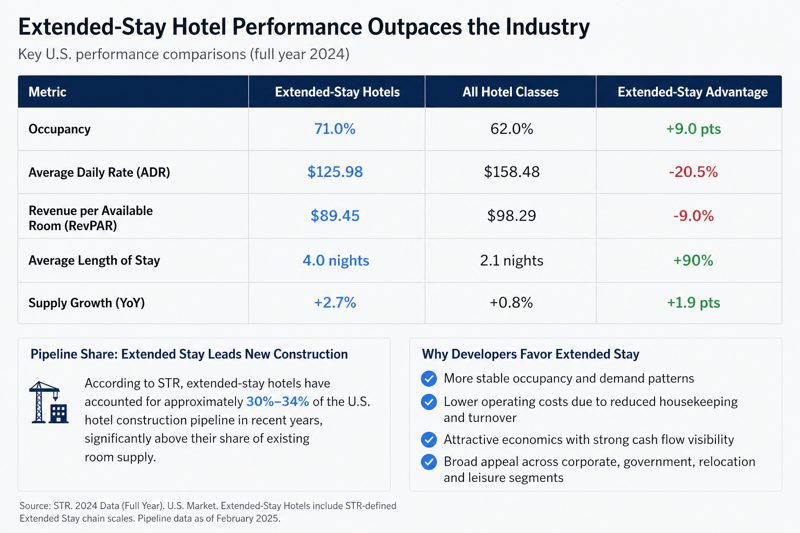
Industry data shows that extended-stay hotels are accounting for an increasing share of new construction activity, particularly in the United States. According to STR, extended-stay projects have made up approximately 30% or more of the U.S. hotel construction pipeline in recent years, significantly higher than their share of existing room supply.
This trend is becoming more noticeable in Europe and parts of Asia, where operators are tailoring the model to local demand patterns.
Operational and Financial Advantages
The appeal of apartment-style hotels extends beyond guest preferences to operational effectiveness.
Extended-stay properties generally benefit from lower housekeeping frequency, reduced turnover costs, and more predictable occupancy patterns compared to traditional transient hotels.
Performance data also indicates the segment’s relative stability. STR reports that extended-stay hotels in the United States consistently achieve higher occupancy levels than the overall industry, often exceeding 70% occupancy, while national averages tend to be several percentage points lower.
These characteristics have made the segment attractive to developers and investors seeking more reliable cash flow profiles.
Extended-Stay vs Traditional Hotels
The rise of apartment-style hotels underscores a structural difference in how properties are designed and operated.
| Characteristic | Traditional Hotels | Apartment-Style / Extended-Stay |
|---|---|---|
| Length of stay | Short (1–3 nights typical) | Longer (multiple nights to weeks) |
| Room design | Bedroom-focused | Living space + kitchen |
| Operational model | High turnover, daily service | Lower turnover, reduced servicing |
| Demand profile | Transient (leisure/business) | Project-based, relocation, blended travel |
| Revenue stability | More volatile | More stable occupancy patterns |
Blurring the Line Between Hotels and Residential
The growth of apartment-style hotels is contributing to a merging of hospitality and residential real estate.
New developments increasingly feature amenities such as kitchens, workspaces, and adaptable layouts, allowing properties to cater to both short-term guests and long-term residents.
This hybrid positioning permits operators to capture a wider range of demand while adapting to changing travel and living patterns.
Outlook
The expansion of apartment-style hotels signifies a fundamental shift in how accommodation is utilised rather than a fleeting trend.
As development pipelines continue to favour extended-stay formats and demand patterns evolve, these models are likely to become an increasingly integral part of the global hotel landscape.