
 FR
 EN
The Hidden Revenue Costs of 'Good Enough' Hotel Websites
Most hotel websites are functioning adequately. They load correctly, present a professional appearance, and fulfil their intended purpose. On the surface, everything seems to be in order.
However, this is precisely the issue.
In the current digital environment, websites that are merely "good enough" seldom fail in overt ways. Instead, they quietly underperform, resulting in revenue losses for hotels without any obvious warning signs. Because there are no technical faults, it is easy to assume that nothing requires alteration.
The hidden cost of stagnation
Guest expectations are evolving at a pace that many hotel websites cannot keep up with.
Search behaviours have transformed. Booking journeys are no longer straightforward. AI-driven discovery tools are altering how travellers find, assess, and compare hotels. Meanwhile, numerous hotel websites still function as static information sources rather than dynamic conversion tools.
This disconnect creates friction throughout the booking process. Not because guests struggle to locate what they need, but because the experience fails to actively guide them toward making a decision. Over time, this friction results in lost opportunities that are challenging to link to a specific problem.
Where "good enough" begins to falter
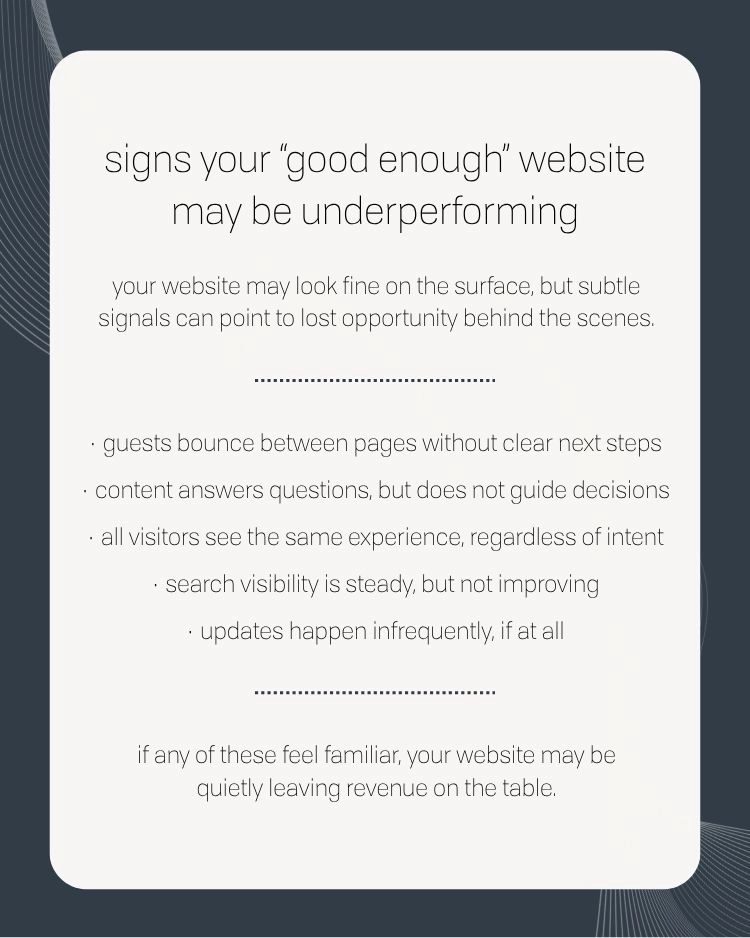
A website may appear polished yet still falter at crucial moments that sway booking decisions. The signs are often subtle, making them easy to overlook.
Content may address common queries but fail to anticipate the intent of guests. Pages might be visually appealing but not optimised for modern search or AI-driven discovery. Every visitor may encounter the same experience, regardless of their position in the booking journey. Calls to action may exist but remain unchanged, even as guest behaviour evolves.
Individually, these issues may seem insignificant. However, collectively, they create friction on a larger scale, particularly for hotels vying for direct bookings in competitive markets.
Conversion is no longer a singular event
Hotel websites were once evaluated based on a straightforward outcome: did the guest complete a booking or not?
In today's landscape, conversion unfolds over time. Guests compare properties, venture off to explore other options, return through various channels, and search again using different terminology and tools. They expect clarity, confidence, and relevance at each stage of this process.
Websites designed merely to exist online are not equipped for this new reality. Without ongoing optimisation and strategic intent, they struggle to accommodate the modern booking journey.
Visibility is also evolving
Search is no longer confined to traditional rankings and keyword placements. AI-driven platforms increasingly dictate how hotel information is presented, summarised, and recommended to travellers.
Websites that are not actively structured and maintained for this shift may still be visible online, but not necessarily in the moments or contexts that are most vital. Over time, visibility can diminish quietly, even if traffic figures appear stable.
The distinction between a vendor and a partner
This is where the difference between a vendor and a partner becomes apparent.
Vendors provide websites. Partners maintain accountability for performance.
A partner looks beyond the launch day and continues to ask challenging questions. Is the website adapting to contemporary guest search behaviours? Is it enhancing visibility in new discovery channels? Is it improving clarity and confidence for potential guests over time?
"Good enough" websites often stem from a one-off mindset. In contrast, high-performing websites are the result of continual collaboration, iteration, and alignment with genuine business objectives.
The importance of this now
Hotels are competing in an increasingly crowded and complex digital landscape. Remaining stagnant is no longer neutral; it represents a disadvantage.
Websites that do not actively evolve may not raise alarms, but they subtly diminish direct booking potential, visibility, and guest confidence. Over time, these minor losses accumulate.
About Vizergy Digital Marketing
For over 25 years, Vizergy has provided the hospitality industry with leading marketing technologies and exceptional service to clients worldwide. Vizergy's platform is user-friendly, turnkey, and SMART — continually enhanced to enable hotels to compete effectively within the market and maximise revenue. By utilising a data-first approach, hospitality marketing is not just a mission but Vizergy's sole focus. Contact our team for further information.