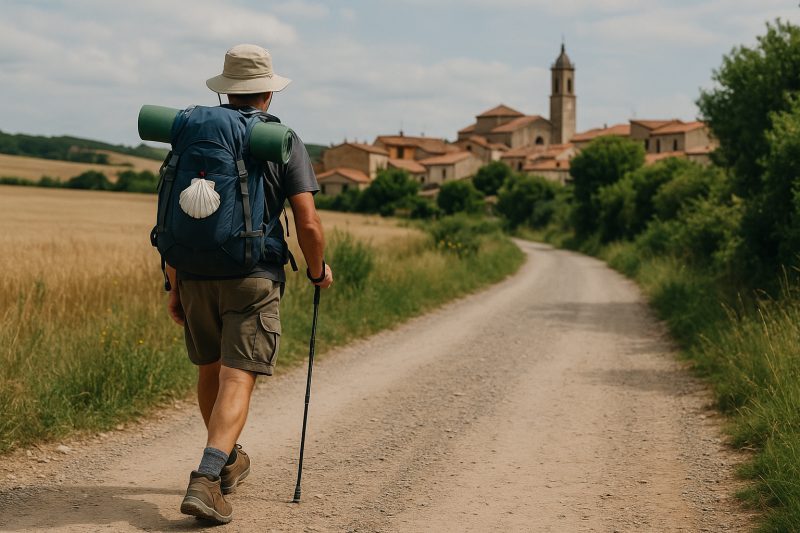
© Dtravel by Canva A story through the centuries The strength of the Camino begins long before departure. Its origins date back to the 9th century, when the discovery of the tomb of Saint James the Greater made Santiago de Compostela one of the greatest pilgrimage centres in Europe.
Between the 11th and 13th centuries, the route established itself as an international path travelled by visitors from all over the continent, including Queen Saint Isabel of Portugal in the 14th century and King Manuel I in 1502. It is this historical depth that distinguishes the Camino: more than just a route, it is a living tradition filled with spirituality and hospitality.
With hundreds of thousands of pilgrims registered each year, the Camino continues to grow and attract an increasingly diverse audience. Several ways to depart… and to arrive Flexibility is one of the great advantages of the Camino de Santiago, offering the possibility to adapt to the time available and the experience sought by each traveller.
The Central Portuguese Way stands out as one of the most popular variants starting from Portugal, with a complete route that begins in Lisbon and heads north through Coimbra, Porto, and Barcelos to the Valença/Tui border. From there, the 118.8 km leading to Santiago de Compostela in Galicia present a medium to low level of difficulty and are accessible to a wide range of profiles.
The choice of starting point varies according to individual schedules: those with two weeks or more generally start in Porto to cover about 240 km in 9 to 12 days before entering Galicia, while those with only five or six days begin their journey directly in Tui.
Finally, there is also the Portuguese Coastal Way, which enters Galicia via A Guarda and follows the Atlantic for 163 km before joining the inland route at Redondela. © Dtravel by Canva On foot or by bike: a crucial choice On foot, the relationship with the territory is slow and contemplative. By bike, the pace is more fluid and the journey gains in amplitude.
This choice has a direct implication on the Compostela (the official pilgrimage certificate). To obtain it, pilgrims on foot must cover at least 100 km, while pilgrims by bike must cover at least 200 km. This is why Tui can be an ideal starting point for those walking the Camino, but it may not suffice for those cycling who wish to obtain certification. Credencial and Compostela:
how to proceed To obtain the Compostela, the pilgrim must carry the credencial (the pilgrim's passport). This document, which can be obtained at hostels or parishes, must be stamped throughout the journey. On the last 100 km (on foot) or 200 km (by bike), it is mandatory to collect at least two stamps per day. Important note:
The Camino can be interrupted and resumed later, provided it remains geographically continuous (starting exactly where one left off). The Compostela is then issued at the International Pilgrim Reception Centre, located near the Plaza del Obradoiro. Hostels and the culture of hospitality The hostels are part of the authentic identity of the journey.
In Galicia, the public network of hostels on the Camino de Santiago was established in 1993 and currently includes 76 centres and over 3,000 beds. Inspired by medieval hospitals, this system perpetuates the centuries-old tradition of hospitality. These spaces for sharing and simplicity allow travellers from around the world to meet after a day of effort.
For many pilgrims, they are an integral part of the experience, just as much as arriving at the cathedral. At the same time, there are private hostels, rural guesthouses, and hotels to adapt the level of comfort to each pilgrim. 2027: Holy Year and Jubilee The year 2027 will be exceptional. It is referred to as the Holy Compostellan Year when the feast of Saint James (25 July) falls on a Sunday.
Tradition dictates that the Holy Door of the cathedral be opened on 31 December 2026 to remain accessible for twelve months. During this jubilee period, pilgrims can obtain the Jubilee (the forgiveness of sins). Whether for the spiritual dimension or the symbolic cultural setting, 2027 will place Santiago de Compostela at the centre of all attention.
For some, this dimension will be at the very heart of the experience. For others, it will primarily be a symbolic and cultural setting that enhances the feeling of arrival. Regardless, the year 2027 is expected to place Santiago de Compostela at the centre of a marked enthusiasm and give even more visibility to the Caminos. A deeply personal experience Here lies the uniqueness of the Camino de Santiago:
the ability to welcome such different profiles within the same tradition. Some depart from Porto for a longer crossing, others start at the border because they have less time, some choose the coastal variant, while others prefer to walk, and some opt for cycling. Ultimately, they all walk towards the same destination, but no one follows exactly the same inner path.
It is through this alliance between collective framework and intimate experience that Santiago de Compostela continues to assert itself as one of the great pilgrimages in Europe. © Dtravel by Canva Dtravel, your partner on the ground Dtravel supports travel professionals in creating tailored programmes for the Camino de Santiago.
Our local knowledge and proximity to partners allow us to design proposals perfectly suited to each type of traveller. Is your next programme passing through Santiago? Contact us: www.dtravel.pt | This email address is being protected from spambots. You need JavaScript enabled to view it. Elisabete João (+351) 91 333 94 79 This email address is being protected from spambots. You need JavaScript enabled to view it. www.dtravel.pt >> Dtravel in the DESTIMAG Directory Other articles The green soul:
why Gerês is Portugal's best-kept secret Surfing in Portugal: much more than waves, an art of travel Portugal: flavours, cities, and experiences to live the country differently Christmas in Portugal: Light, Flavour, and Tradition – A Destination that Warms the Soul in Winter Algarve: Three Regions, Three Unforgettable Summers

 FR
 EN